



Five Theatres in One: How NÜSSLI Reinvented Temporary Architecture in Kassel
- vor 5 Stunden
- 4 Min. Lesezeit
What if a temporary building could offer more flexibility than the permanent one it replaces? In Kassel, Germany, NÜSSLI has built a fully equipped theatre that can transform between five fundamentally different configurations, accommodate everything from opera and dance to concerts, and eventually be dismantled and rebuilt elsewhere. What began as a solution to a renovation problem is demonstrating how temporary architecture can become something far more ambitious.
by Archie Marshall || 21 August 2026
A theatre built because the old one could no longer perform
The permanent opera and theatre house of the Staatstheater Kassel was built in the 1950s. Today, neither its building fabric nor its stage technology meets modern requirements, while its stage machinery can no longer be operated safely. For an institution employing around 600 people, however, simply closing for the several years required for renovation was not an option. The performances had to continue.
That created a very specific construction challenge: Kassel needed a fully functioning theatre, but only for the period in which its permanent venue was being renovated. The answer was the interim, a purpose built temporary theatre on the site of the former Jägerkaserne I.
Following a Europe wide tender, NÜSSLI was appointed as the project's total contractor in May 2024. The company took overall responsibility for planning, construction, stage technology, acoustics and technical building services, rather than simply delivering the structure itself. From planning to opening, the project took roughly one and a half years, with the Interim welcoming its first audience on 31 October 2025 with Giuseppe Verdi's Aida.
The speed of delivery was impressive, but it was only half of the challenge. If the building was going to serve as the Staatstheater's home for several years, it needed to function as a genuine theatre rather than a stopgap venue. NÜSSLI therefore designed the Interim around a different principle: temporary did not have to mean limited.
Five configurations: One building
The INTERIM is based on a modular steel-truss construction, with speed and complete dismantlability built into the concept from the beginning. Prefabrication allowed the stage floor, stage technology and fly tower to be installed in parallel, while an overhead temporary framework carrying 80 motors enabled different construction processes to run simultaneously.
Inside, the result is closer to a permanent high performance theatre than a conventional temporary structure. The usable stage measures 25 by 50 metres, with up to 18 metres of clear height, while more than 160 containers around the building provide dressing rooms, make-up facilities, storage and technical spaces.
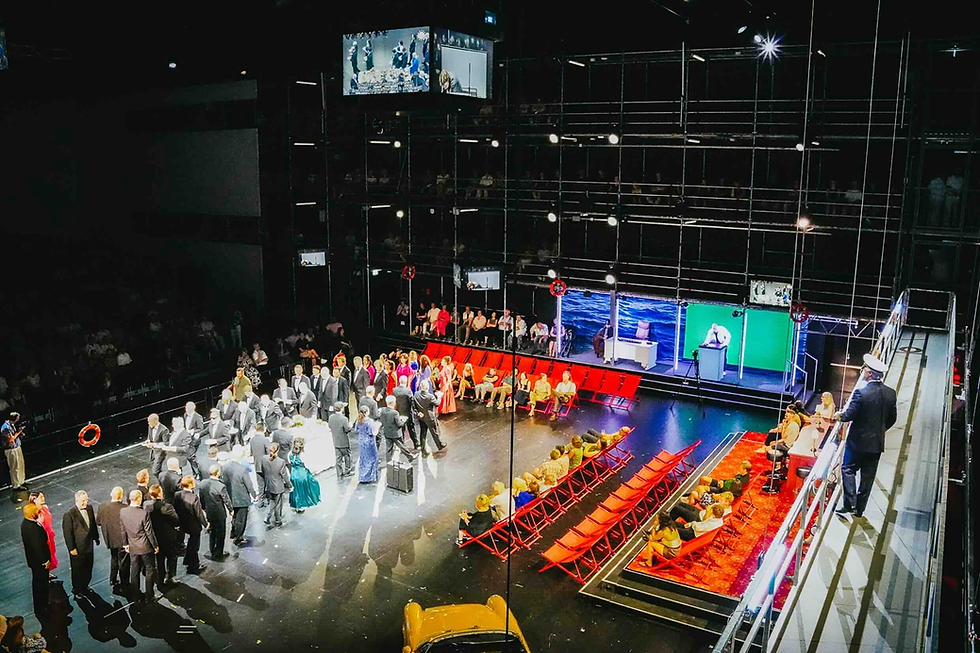
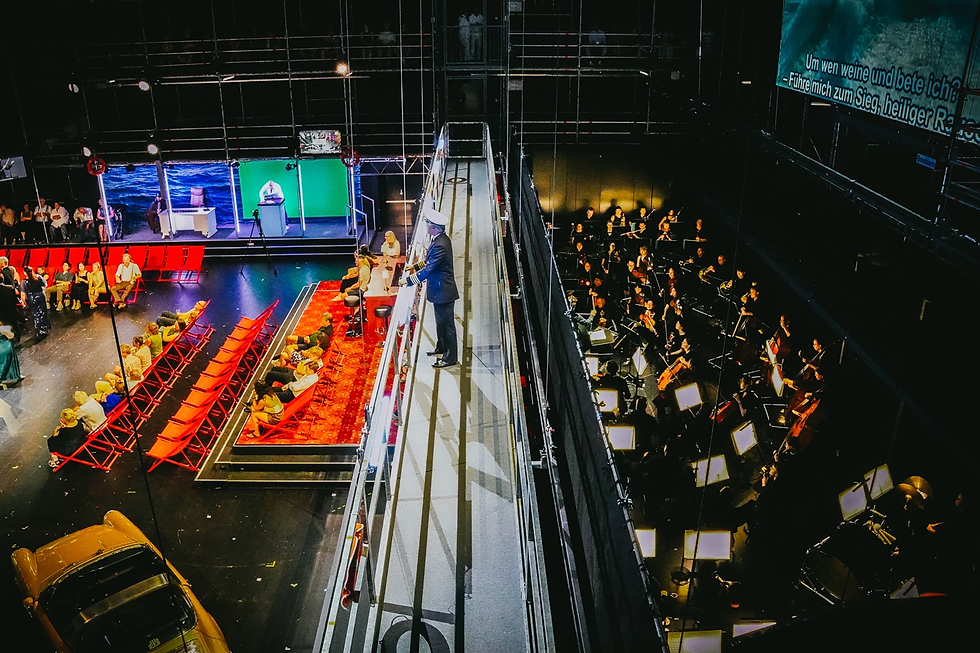
The real innovation, however, lies in the way the interior can be transformed. An 18 metre diameter heavy duty turntable embedded in the floor can carry up to 80 tonnes, allowing it to support major stage constructions or even an entire audience tribune. An overhead stage machinery system with 28 lines stretches across the full length of the space, while a four storey gallery can serve simultaneously as audience seating, playing space and a lighting level.
Together, these elements allow the Interim to take on five fundamentally different configurations, ranging from a conventional proscenium theatre to a 360-degree arena. The architecture can therefore respond to the production rather than forcing every production into the same architectural template.
That flexibility was put on display immediately with Aida. With more than 200 people involved, Verdi's opera is one of the most spatially demanding productions in the repertoire. Under Staatstheater Kassel Intendant Florian Lutz, the traditional boundary between stage and auditorium was deliberately broken down. Audiences experienced the production from the rotating main tribune, orchestra seats around the pit, four gallery levels and even positions directly on the main stage.
The building was no longer simply the place where the performance happened. It became part of the performance itself.

A building designed for its next life
Perhaps the most important detail is what happens when the Interim is no longer needed in Kassel.
The building is expected to remain there for around five to six years, after which the entire structure can be dismantled and rebuilt at another location. Its modular construction is therefore not simply a way of making the project faster to deliver. It is also a strategy for giving the building a second life.
That challenges one of the assumptions traditionally associated with temporary construction. Temporary buildings are often thought of as structures that are built quickly, used for a limited period and ultimately removed. The Interim instead treats temporary status as part of a building's lifecycle: assemble, use, adapt, dismantle and reuse.
For cities facing major renovation projects, that could become an increasingly attractive model. A temporary venue no longer has to be a compromise between doing nothing and committing to another permanent building. It can provide the capacity needed today while remaining adaptable to a completely different requirement tomorrow.
The broader lesson from Kassel is therefore not simply that NÜSSLI can build a theatre quickly. It is that temporary architecture can be designed with the same ambition as permanent infrastructure while offering something permanent buildings often cannot: the freedom to change.
The Interim can change its configuration, its relationship with the audience and the way productions use its space. And when its role in Kassel is complete, the structure itself can be dismantled and rebuilt elsewhere.
NÜSSLI did not just build a temporary theatre. It built a theatre designed around the idea that its next configuration, and eventually its next location, does not have to be known today.
About NÜSSLI
NÜSSLI is a global event and construction services provider specialising in the planning and delivery of complex infrastructure for sporting, cultural and business projects. The company combines project management and construction expertise to deliver structures and venues that often have to be realised under significant time pressure.
Founded in 1941, NÜSSLI traces its origins to founder Heini Nüssli's invention of a wedge coupling that helped revolutionise event construction. The company today employs around 460 people across 21 locations worldwide and delivers approximately 1,500 projects each year.
From temporary cultural venues to major sporting and business infrastructure, NÜSSLI's work centres on connecting construction, technology and event requirements to create spaces where audiences can experience events up close.